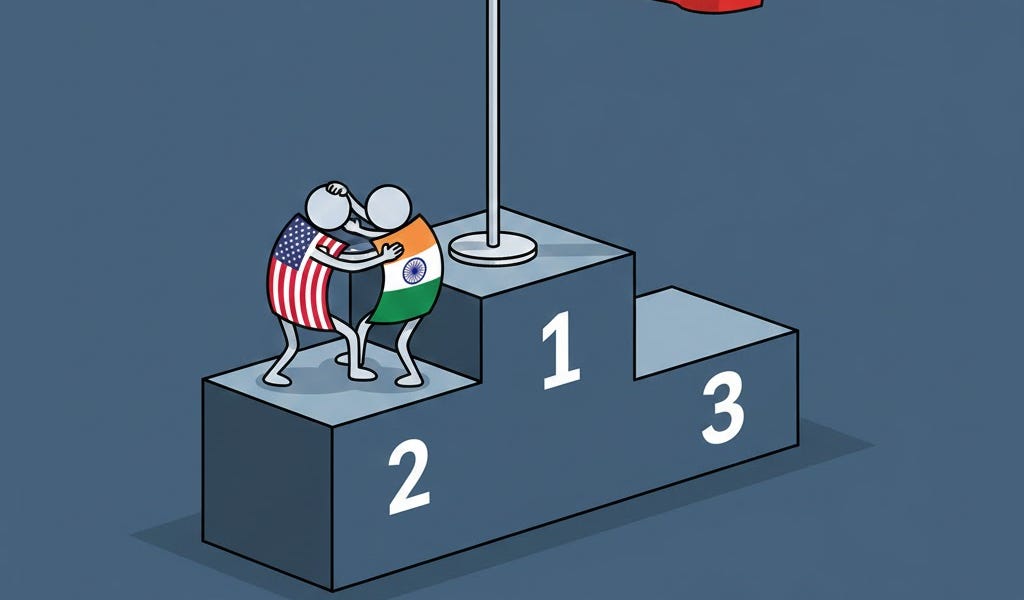
Allies aren’t there to help encircle China or Russia anymore - they’re there to be tapped: their markets opened to American goods, their industries subordinated to American priorities, their resources extracted to revitalize a declining hegemon.
The relationship has gone from predominantly strategic to overwhelmingly parasitic.
This logic explains what otherwise looks like incoherence. Why is Washington harsher on say Europe than on Russia? Because Russia has power - and continuing confrontation risks accelerating American decline. Europe does not (or, rather, it could have power but it prefers to bend the knee), making it a safer target.
Glad to see there are more people out there than just us communists who understand what is actually going on.
In the long run India will be the number two global power. It’s inevitable. It’s just math. They have four times the population that the US does. Once the West’s technological force multiplier is erdoded away, the main determinant of global power will be population (as well as the land to feed that population) and access to resources. And India has both.
In the long run India will be the number two global power.
I agree (long run being the key qualifier here, given all value under capitalism is labour and India’s population size will therefore not be the limiter). Just wished they didn’t repeatedly engage in continous domestic mass social murder.
Indeed. And bad governance is not just a humanitarian problem, it actively hampers development. Many of the economic resources that could go toward China-style development are instead squandered, siphoned off by oligarchs and foreign capital. Ethno-religious tensions and nationalist demagoguery are used to distract the population. It’s the same trick that any sleight of hand magician uses: keep the attention of the audience focused on one hand while the other steals your wallet.
We have to remember becoming number 2 for a population the size of India ain’t that big a feat. US annual GDP= 30 trill. India = 20 trill adjusted for ppp. Per capita for india is about 3k; is it unfathomable for it to jump to 4.5 - 6k per capita ? I don’t think it requires that much of a leap; just the West to “fail”. India could do it really inefficiently, as it is presently doing, and still reach there.
I think it is a failure of capitalism that India isn’t already at number 2. This is what happens when you don’t have imperialism to subsidise your GDP.
Agreed.
Exactly, the population advantage alone ensures it, but India is also positioned better geographically because it’s right next to what’s becoming the new economic center of gravity globally.
An interesting but at times painful read.
But his wisdom goes way beyond India. Long-time followers will recall I’ve written about his thoughts three times before: first on his analysis of Chinese youth and their pragmatic rejection of Western ideological tribalism, the second time on his striking parallels between Trump’s DOGE movement and episodes like Khrushchev’s secret speech and China’s Cultural Revolution, and lastly I shared an article he wrote about interpreting Nezha 2 geopolitically.
So following the striking–parallels links leads us to:
He argues however that the actions of the new administration remind him of those of Khrushchev in the Soviet Union “who, in his secret speech at the 20th Congress of the Soviet Communist Party, exposed many of Stalin’s dark deeds. Although this consolidated his political position in the post-Stalin era, it permanently damaged the Soviet Party’s domestic authority and international moral standing, with the Sino-Soviet split being the most direct result. [Similarly,] Musk and Trump’s tireless efforts to expose the so-called ‘deep state’ are certainly beneficial to the new administration, but the damage they are inflicting on America’s institutions and moral authority is irreversible and incalculable.”
Oh dear.
Why such harshness with India? Mao [Keji]’s answer is that, essentially, India is becoming what China was - a rising power that won’t bend the knee.
I can’t think of a country from the Global South more reactionary and more western knee-bending relative to its population size and resources than India(n federal governments).
If India ever becomes number 2 these guys’ takes ain’t appearing to be it.
Kids please learn dialectical materialism.
It’s definitely hit and miss in terms of analysis, but I do think India has ambitions beyond simply being a vassal of the US. And that is where the tension is now growing. I personally don’t expect that pattern to change going forward. The US will keep putting higher pressure on India, and that will force India to integrate further with the BRICS. India might be reactionary, but they are smart enough to understand that they don’t want to end up like the EU, Japan, or occupied Korea.
It might be reactionary, but they are smart enough to understand that they don’t want to end up like the EU, Japan, or occupied Korea.
I’m not so sure at present. There is a reason why Fair and Lovely is still a billion dollar industry.
force India to integrate further with the BRICS
I have a tendancy to credit Russia and China here.
I do think you are right that the overall drift for India to face East/South is true especially as the consumer and import market there will be an increasing share of global demand relative to the declining West.
We already have evidence of this when the US put pressure on India to stop trading Russian oil. India is not willing to sacrifice lucrative trade to appease the US, and the US is not in the habit of letting countries pursue their national interest. Hence there’s going to be increasing friction going forward. As the US power declines, they will be putting increasing pressure on their vassals to ratchet up extraction. Unlike the Europeans and American vassals in Asia, India has options precisely because it is part of BRICS.
Haha I guess it is a question of dialectics whether we “credit” India or whether we say her hand is forced with the tide of geopolitics swayed significantly by the R and the C.
Their hand is being forced, but they do get credit for actually having the brains to leave themselves with some options.
I agree. They were forced to make a choice, just like Europe was. India chose sovereignty. Europe chose subjugation.
Exactly, Europe put all their eggs in the imperial basket, while India kept their options open.
I would strongly consider how white supremacism and colourism is deeply ingrained into the upper classes of India, and the material conditions, ie the relationships these classes have with western nations and non-western nations, that affords them this.
India since independance has long history (and I would say even before Independance when Gandhi suggested that India remain a protectorate of the British Empire) of knee bending to the West despite any rhetoric (egregious example: Indira Gandhi despite all her western interviews and erudite anti-western rhetoric was more than happy to engage CIA help to topple home grown communist movements), and it is difficult to imagine a present timeline where India would have apparently chosen their own sovereignity without Chinese and Russians showing a backbone.
I mean we already have concrete evidence, as I noted earlier, with the Russian oil trade. You have to apply material thinking to the situation. Trade with BRICS is creating a lot of wealth for the oligarchs in India, and they’re becoming a powerful political force in turn. Meanwhile, as the US economy continues to decline, the oligarchs invested in the US are starting to find that they’re not getting the returns they used to get. So, the economic gravity necessarily shifts away from the US and towards BRICS where development opportunities are. Russia and China created the economic niche with BRICS, but now that it exists, India is pulled towards it.
I’m not so sure at present. There is a reason why Fair and Lovely is still a billion dollar industry.
I have to say that this is a really idealistic and frankly dumb comment. The actions taken by the ruling class of a nation depend on the class situation and economy. And India is too big as a single political entity to just remain as a vasal/dickriders in the long term to the US. As Indian capital accumulates, the national bourgeoise of India will not be content with being mere subordinates.
The situation is different with Japan, south Korea, and the EU. The former 2 were directly militarily occupied by the US. The latter is highly divided, and its members were also militarily occupied by the US during WW2 and the cold war.
I have to say that this is a really idealistic and frankly dumb comment. The actions taken by the ruling class of a nation depend on the class situation and economy.
It was a nod to white supremacism. We have to consider marxism is not a theory of anti-elitism. The reactionary masses who hold political power is not limited to the richest few.
The rest of your comment does not appear too much in disagreement with the rest of the comments I have made on this post.
It was a nod to white supremacism.
The Indian ruling class has colorist and pro-western brainworms, but using the ideas of white-supremacy to say anything about the decisions they will make in the long-run just boils down to a form of idealism.
It would be no different from me saying that the Americans wouldn’t mind becoming Ukraine 2.0 because America has a lot of nazis.
The Indian ruling class has colorist and pro-western brainworms, but using the ideas of white-supremacy to say anything about the decisions they will make in the long-run just boils down to a form of idealism.
White supremacy is an ideal based on material conditions, we have to consider what those material conditions are that amplify this. It’s those material conditions that help explain the decisions that people make whether long or short term. But I didn’t use it as a reason why India may or may not become number 2. In fact I think it is inevitable given enough time and what we know currently they will become number 2.
It would be no different from me saying that the Americans wouldn’t mind becoming Ukraine 2.0 because America has a lot of nazis.
This bit I don’t understand. White supremacism does not necessarily mean the richest see themselves subservient; in this context the Indian elite act like Honorary Aryans, they would like to be the top “Whites” so exceeding the US would not be outside of their class paradigms.
What it comes down to is this part
in this context the Indian elite act like Honorary Aryans, they would like to be the top “Whites” so exceeding the US would not be outside of their class paradigms.
Increasing wealth and accumulating value are fundamental drives of capitalism. White or not, the desire to be seen as Honorary aryans has little to do with it. And it’s not as if they can’t keep acting white while the nation itself pursues a nationalist capitalist development path (look at Russian liberals)
I find the dissolution of the Indian republic more likely than it ‘battling for second place’
I wouldn’t go that far. The biggest existential threats the Indian state faces are Pakistan and the Maoists and neither are powerful enough to warrant concerns for resolution.
The real problem with the “India competing for second” theory is that our technological base is not close enough to be good for that. Investment in critical public services like education and healthcare is really low and prospects aren’t improving. India has never even pretended to compete with the US for anything. A significant part of our economy is selling services and low value added goods to the US which is very important for the Indian bourgeoisie.
On the flip side, the US industry has been eroding for decades, accounting for only around 11% of the economy today. And the rate of deindustrialization is actually accelerating under Trump thanks to the tariffs. Same problem with healthcare, education, and other essential sectors. So, it might not be the case of India catching up in a significant way, but rather of the US regressing to the point where India becomes a serious competitor. And the likely financial crash that will result from the AI bubble popping could be a catalyst for the entire US economy imploding. At that point consumption will also drop which will make selling goods and services to the US a lot less lucrative. I think the big question is how big of an impact that will have on India.
The problem with his analyses is it doesn’t consider just how much of India’s industry is reliant on the US clientele. Most of the consumption expenditure in India is driven by the top 10%. The majority of this 10% is comprised of IT workers working for American corporations that outsourced to India.
Once that vanishes, India’s in a horrible position as it has no internally developed economy like China that can keep the economicnc cogs moving
Agriculture is around half the economy in India and where large chunk of the workforce is. I expect the crash will largely affect the upper crust which might actually lead to positive social change.
India is actually #2 in exporting refined fuels after Russia I believe. They are also big in pharmaceuticals especially generics.
Seems like the dissolution of the US is a far more likely scenario the way things are going.
Balkanization especially so
India is getting nowhere. It has a top 10% who are the consumer base and rest extremely poor (much worse inequality than China or the US). Real wages even among the salaried have been stuck since like 2010.
More recently, they weakened labor laws and ended rural job guarantee with zero consultation so as to please international capital.
The question is whether India is developing in an equitable way is beside the point here. It’s a huge country that can obviously challenge the US going forward. That’s the source of tensions between them and the US.
I don’t think so. The present regime is captured by oligarchs who have financial interests in the US. All the Indian bureaucrats and ministers have their children studying in the US.
The last point I made wrt labor laws is also related since India was doing it because of Trump tariffs, the strategy is to reduce labor costs so capitalists earn more profits and India get to export and receive capital flows (from the US).
Yet, we can already see that when the US demanded India stops trading Russian oil, that didn’t happen. The US is structurally incapable of treating other countries as sovereign. So, they will continue trying to impose restrictions on India which will end up pushing them further towards BRICS. You’re reading far too much into the fact that the oligarchs in India have interests in the US. Capital has no nation, and if the US economic situation continues to decline, which it will, and new niches start opening up, that’s where capital will move.
The question then remains how will they earn whatever foreign currency they need to import?
India has one reliable source of foreign currencies, remittances from Gulf and the West. The other half is net capital flows. India’s trade deficit with China exists because of these. There is also very vulnerable services exports (which India has a surplus with the US) which will decline if India tries decoupling further pushing down imports and all.
There are a lot of hopefuls in that, Trump tariffs have been devastating for the economy, yet the Government instead of decoupling and trying to improve domestic demand, doubled down on internal devaluation instead. Will that characteristic change? Maybe depending on the pressure the US puts on capitalist profits.
I don’t really see how holding dollars helps India here. The dollar is rapidly losing value, and yields on US bonds are going up. It’s simply not a good store of value anymore, hence why we see central banks dumping dollar for gold at an accelerating pace now. Meanwhile, trade outside the dollar is already thriving with bilateral swaps which became necessary to trade with Russia after they were kicked out of SWIFT. Now that the system is established, there’s far less need to hold dollars to do trade.
bond yields are pegged, dxy is stable relatively. central banks mainly buy gold to turn dollars into more dollars later. India is only able to trade with Russia (or at the least net import) because it obtains UAE Dirhams, again by exchanging Dollars it has. The question is how India will be able to import as it does now without capital flows, services exports gone and remittances reduced. One way would be for China and others to transfer certain sums of Yuan to India’s account (either for ‘free’ or in exchange for Rupees). That’s what Americans do, they buy Rupee denominated assets, India exports electronic entries and paper which shows up under capital/financial account which finances India’s trade deficit with China and oil exporting countries. Without non-trade components, trade is reduced to barter-like arrangement.

Sources and Uses method can be a good way of looking at it. India’s source of foreign currencies include mainly: Services surplus (IT exports), Net Capital Flows (Financial and Capital Account), Net Transfers (mainly remittances from abroad), Draw upon reserves (they do it when exchange rate is under pressure). It uses these sources to pay for Goods Imports (oil, electronics etc from China, Gulf, Russia etc), Accumulate Reserves (i.e. reserves increase), Net Income (dividends, interest paid on domestic shares which go abroad).
You’re kind of missing the forest for the trees on how trade finance is actually evolving. The idea that everything has to route through dollars is exactly what countries like India are trying to move past. It’s not about some fantasy barter system but about building new plumbing.
First off, the whole bond yield thing. It’s not that yields are magically pegged. When a central bank does QE, it’s literally buying up its own debt in massive quantities, which artificially pushes the price up and the yield down. The value gets destroyed over time because that policy, if it goes on too long, invites inflation. Inflation eats the fixed coupon of the bond for breakfast. So the loss is real, either as a capital loss if you sell or as a silent erosion of purchasing power. The stable DXY lately is more about relative misery than dollar strength.
On central banks buying gold, framing it as turning dollars into more dollars later is a wild misinterpretation of their motive. They’re not day traders. They’re risk managers. After watching the US freeze half of Russia’s reserves, buying gold is about getting a real asset with no counterparty risk. It’s de-dollarization 101 as opposed to some yield play.
India doesn’t need to first get dollars to pay the UAE. That’s the old world. The new world is direct currency swaps. Here’s how it could actually work. The central banks of India and the UAE set up a swap line, agreeing to exchange, say, a pile of rupees for a pile of dirhams. Then when an Indian refinery needs to buy UAE oil, it pays in rupees to its bank. The RBI taps the swap to get dirhams for the payment. The UAE exporter gets paid in dirhams. The UAE central bank now has those rupees sitting in an account, which it can use to pay for Indian software services or textiles. The dollar never enters the chat. This is the explicit goal of India’s rupee trade settlement systems they’re building right now.
The broader point about financing deficits is fair, but it assumes the current structure is permanent. If capital flows and remittances dried up, the trade deficit would collapse on its own because India simply couldn’t import as much. The adjustment would be brutal and involve a lot of import substitution and austerity. The endgame is to reduce the dollar’s role as the mandatory middleman in trade, so that bilateral trade balances can clear in local currencies.
Sources and Uses are actually a perfect way to frame the vulnerability. The classic breakdown you just laid out is the textbook picture of a managed, dollar-dependent economy. But looking at it that way also shows exactly why the whole thing is so fragile and why the shift to direct swaps becomes attractive.
The services surplus and those rock solid remittances bring in the real dollars year after year. Meanwhile capital flows are fickle money that’s chasing yield, and it can reverse in a heartbeat when global risk sentiment shifts or the Fed hikes rates. That’s a volatile source to depend on for funding something as essential as oil and electronics imports.
So the current use of those sources is basically a balancing act to fund a persistent goods import habit, which is the trade deficit. When capital flows are gushing in, the RBI can even add to reserves. When they dry up or reverse, that’s when they have to draw upon reserves to defend the rupee, exactly as you said. It’s a system that works until suddenly it doesn’t, because all those uses are hard-coded in dollars.
This is where the local currency play changes the game. The goal isn’t to magically eliminate the goods import bill but to denominate a chunk of it in something other than dollars. If, say, 20% of your oil from the UAE is paid for in rupees via a swap, that’s 20% less of your precious sources that get burned up just to buy dollar liquidity first. It effectively takes that portion of the import bill off the dollar led Sources and Uses ledger.
It frees up your hard dollar sources to cover imports that absolutely must be in dollars, or to act as a bigger buffer. Over time, if you build enough of these bilateral corridors with major partners, you start to firewall your essential trade from the whims of the capital account. The Uses side gets a new, less volatile funding option. It doesn’t solve the deficit overnight, but it makes the whole structure less prone to a crisis every time the net capital flows source decides to take a vacation. The idea is to have redundancy in the plumbing so you’re not praying for portfolio inflows just to keep the lights on.
Wealth distribution in the US appears to be heading in that direction as well, in case you haven’t noticed. If you have two systems that are both extremely unequal and both hollowed out by corporate oligarchies, neoliberalism and deregulation, the one with the larger population has an advantage just by virtue of manpower resources. The biggest structural advantages the US still has over India are a much more developed infrastructure and a legacy of historical investment in human capital, and it is exactly these two aspects which have begun to be catastrophically neglected in the US. If India can fix these shortcomings it can overtake the US.
Absolutely not, and this AI slop written substack makes no constructive argument as to why. Population isn’t a guarantee of anything. Sub Saharan Africa has a population of over a billion right now, expected to be 2 billion by 2050. No one is talking about the SADC becoming a superpower alliance. No one is talking about South Africa being a world leader. India is well behind the US and China on advanced domestic manufacturing and industry, decades behind at minimum, while China and the USA continue to advance. There is no guarantee that nations and blocs with large populations will close the technological gap, unless a concentrated effort is made to do so, through institutional reform. It’s taken China decades to get to where they are today, and a mass reform of their governance and institutions (Maoism, Dengism and post Deng current governance) to develop their advanced technology and industrial capacity. “India superpower” is a meme, especially under the current government and institutions.
In reality, the US and China will be the leading nations and only true superpowers, with subordinate powers in the European sphere of influence. The EU will be subordinate to the USA, Russia subordinate to China. The Pacific theatre is far more interesting and important for US - China security and great power competition. Japan and South Korea will play more important roles for the US than India here. India can be some leader of a “non aligned” movement, but they lack the influence for anything more currently. India itself is embroiled with territorial disputes with China and Pakistan, with Pakistan being armed by both the US and China.
AI slop
Always on to a winner when this phrase comes along.
India may be dragged into being number 2 due to Western decline + forced to turn east + population size. Doesn’t mean it won’t take a long time to get there.
You would have to bet that other countries with smaller population sizes would reach a higher GDP per capita to and maintain a total GDP more than India’s total for the long run. So unless those countries turn socialist they will then remain capitalist but now with an increasingly decreasing imperialist subsidy. Not sure if the maths adds up.
All of the above assumes USAmerican imperialism over the Americas doesn’t work out. I think in the long run it won’t.
I’m sorry I just hate reading obviously AI written substacks that have no constructive points made. What’s the point? Just outsource all thinking to the machine.
Our end point is roughly the same (workers need to organize) but man alive do I disagree with that writer’s lengthy reasoning and observations. It feels like he’s responding far too earnestly to a few dozen specific social media straw men and influencers and barely mentions why your average working or part-time artists feel threatened by the rise of generative AI, or what these workers should actually do in the meantime as their means of living disappear into data centers.
Generative AI as it exists from the Big American Tech Companies is irredeemably evil and I have yet to see any convincing arguments for using it. These closed-source models are capitalist tools built for capitalist goals consuming titanic amounts of resources and money so billionaires don’t have to pay humans for artistic labor. Every prompt eats bottles of fresh water and piles of fossil-fuel power. The data centers are ruining human quality of life all over the world with their noise and consumption.
Why should I contribute to that in any way?
(Self-hosted open-source models are far less harmful anyway.)
Their analysis is the critique against artisanal reaction but now applied in the context of AI; a lot of westerners’ “marxist” takes is just proudhonism and the author was using this as an example to highlight that.
There is no reason why the average Indian, given sufficient investment in human capital and infrastructure, should not be able to generate just as much value as the average American, European or Chinese. The same goes for those Sub-Saharan African states which are rich in natural resources and whose climate allows them to support a large population. It’s just a question of development.
The border disputes between China and India or Pakistan and India are a nothing-burger. They were useful for the Western imperialists during the Cold War as points of friction to prevent regional integration and stoke confrontation. Now they are mostly used by the political elites of India and Pakistan to distract from domestic economic issues.
As the region sees increased development and economic integration, and as the economic situation of the people improves, those points of friction cease to be as relevant, as none of the parties involved will want to rock the boat of lucrative economic ties. The remaining disputes can then be resolved via simple bilateral negotiations just like China and Russia resolved their own long-standing border disputes.
Japan and South Korea are likely to decline significantly in relevance as the global south rises. They are after all relatively small in the grand scheme of things and relatively resource-poor. They have been artificially propped up by the American empire due to their geostrategic position, but US power is now receding and allies are becoming liabilities.
Russia is not subordinate to anyone, they are the world’s largest country, a nuclear superpower with the largest abundance of natural resources on the planet. And with climate change opening up the arctic transport corridors they are looking to rise to an even more powerful position of global economic importance, even post-fossil fuels.
As for the EU, it is unclear how long it can even still last for. It will probably break up at some point, same as NATO. Until then, yes, Europe will remain marginal and subordinate, having tied their boat to the sinking ship of the American empire.