On the flip side, the US industry has been eroding for decades, accounting for only around 11% of the economy today. And the rate of deindustrialization is actually accelerating under Trump thanks to the tariffs. Same problem with healthcare, education, and other essential sectors. So, it might not be the case of India catching up in a significant way, but rather of the US regressing to the point where India becomes a serious competitor. And the likely financial crash that will result from the AI bubble popping could be a catalyst for the entire US economy imploding. At that point consumption will also drop which will make selling goods and services to the US a lot less lucrative. I think the big question is how big of an impact that will have on India.
The problem with his analyses is it doesn’t consider just how much of India’s industry is reliant on the US clientele. Most of the consumption expenditure in India is driven by the top 10%. The majority of this 10% is comprised of IT workers working for American corporations that outsourced to India.
Once that vanishes, India’s in a horrible position as it has no internally developed economy like China that can keep the economicnc cogs moving
Agriculture is around half the economy in India and where large chunk of the workforce is. I expect the crash will largely affect the upper crust which might actually lead to positive social change.

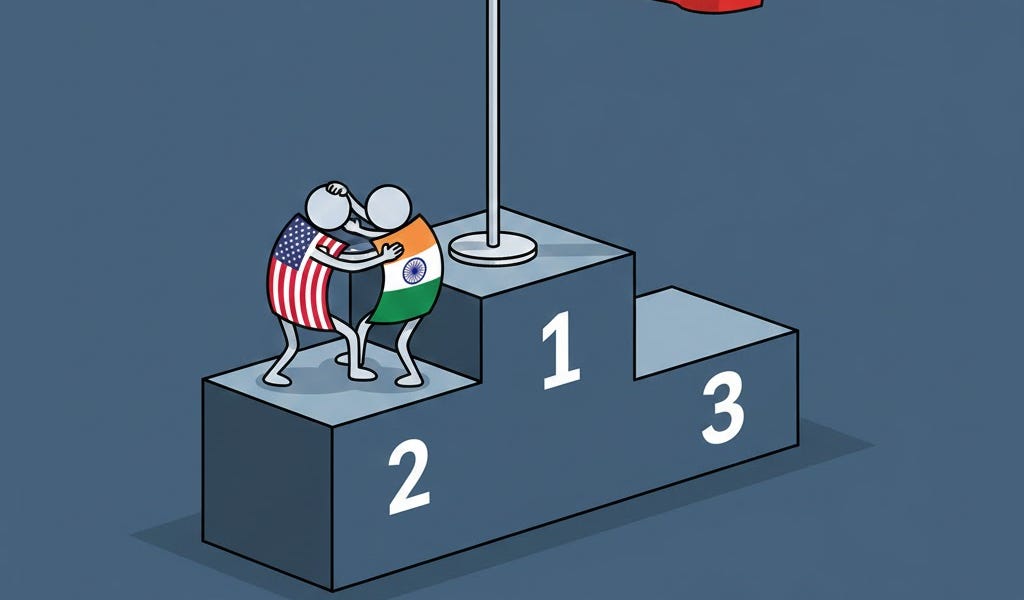
On the flip side, the US industry has been eroding for decades, accounting for only around 11% of the economy today. And the rate of deindustrialization is actually accelerating under Trump thanks to the tariffs. Same problem with healthcare, education, and other essential sectors. So, it might not be the case of India catching up in a significant way, but rather of the US regressing to the point where India becomes a serious competitor. And the likely financial crash that will result from the AI bubble popping could be a catalyst for the entire US economy imploding. At that point consumption will also drop which will make selling goods and services to the US a lot less lucrative. I think the big question is how big of an impact that will have on India.
The problem with his analyses is it doesn’t consider just how much of India’s industry is reliant on the US clientele. Most of the consumption expenditure in India is driven by the top 10%. The majority of this 10% is comprised of IT workers working for American corporations that outsourced to India.
Once that vanishes, India’s in a horrible position as it has no internally developed economy like China that can keep the economicnc cogs moving
Agriculture is around half the economy in India and where large chunk of the workforce is. I expect the crash will largely affect the upper crust which might actually lead to positive social change.
India is actually #2 in exporting refined fuels after Russia I believe. They are also big in pharmaceuticals especially generics.