This is a shared profile used by multiple critics and whistleblowers who aim to expose issues at Wikipedia and WMF, who may hold political views of different stripes.
For privacy and safety reasons we tend to stick to Wikipedia-related topics only. Thank you for your understanding.
- 11 Posts
- 15 Comments
wikipediasuckscoop@lemmy.worldOPto
Technology@lemmy.world•Unethical conduct in Wikimedia FoundationEnglish
3·1 month agoThat’s right. Many Global South topics are more likely to be affected by deletionism than the WASP ones. “Wikipedia has a left wing bias” is just a misnomer.
wikipediasuckscoop@lemmy.worldOPto
Technology@lemmy.world•Unethical conduct in Wikimedia FoundationEnglish
2·1 month agoWe have to use this generic username instead of more identifiable one exactly because of the fear of retaliation, which by now thanks to the blog author and so on, seems really like a pattern instead of isolated incident. If we participate on other topics apart from Wikipedia there’s the risk of people using what we’ve frequently posted to try to deanonymize us.
it_depends_man ultimately has a fair point while another probable WMF staffer kubofhromoslav just weighed in here echoing the concerns.
wikipediasuckscoop@lemmy.worldOPto
Technology@lemmy.world•Unethical conduct in Wikimedia FoundationEnglish
3·1 month agoHope that Bernadette Meehan will have the guts to correct all the issues, but guess we’ll see.
wikipediasuckscoop@lemmy.worldOPto
Technology@lemmy.world•Unethical conduct in Wikimedia FoundationEnglish
2·1 month agoTheir point still stands, but on the other hand you’re no different than the supporters of the Maine oystenfuhrer who dismissed concerns about his character and attacked those who raised it, or maybe some paid bots of Theranos in 2015.
Fair warning: You’d want to get a lawyer soon if you’re entangled with toxic nonsenses at Wikipedia in so many ways, because at the rate we see it, the chickens are about to come home to roost and it’s not gonna end well for you. We’ll leave the question open on what direction everything in this context are converging into.
wikipediasuckscoop@lemmy.worldOPto
Technology@lemmy.world•Wikipedia Editors Could Strike Following LayoffsEnglish
1·3 months agoVolunteer editors make up a vast majority of the workhorse in the encyclopedia. Here’s a post on how the strike will look like.
At WP:VPWMF § Petition: Editors willing to join in collective labor action, I’ve suggested the possibility of Wikipedia’s editorbase going on strike in solidarity with Wiki Workers United. As I stress at VPWMF, the details of such a strike would only be finalized in the event that a strike happens; supporting the conditional commitment to strike does not mean supporting exactly what I’ve written in this document. However, it seems prudent to sketch out an idea of how a strike might work, which is what I aim to do here.
What would the strike prohibit? Editors on strike would agree to refrain from any on-wiki activity that does not in some way further the goals of the strike, except as necessary to preserve the dignity of our readers, editors, and living biographical subjects. In particular, they would not: Edit or take other actions on content pages[a] or their talk pages, except to remove content that is so egregiously inappropriate as to require revision deletion, suppression, or speedy deletion as an attack page Revert, warn, or block accounts for routine violations of the vandalism policy, the username policy, or any content policies Participate in content improvement or curation processes such as Wikipedia:Good article nominations or Wikipedia:Articles for deletion How would the strike be enforced? The strike would be strictly voluntary. No one would be blocked or otherwise administratively sanctioned merely for not participating. However, nothing prevents striking editors from lobbying other editors to join, even in strongly-worded terms, so long as they are civil and do not harass people. Furthermore, nothing prevents striking editors from imposing social consequences against those who cross the picket line, for instance by saying that upon the end of the strike they will not review good article nominations or featured article nominations by former strikebreakers.
Would this require community consensus? Individual participation in the strike would not require community consensus. Organizing the strike and encouraging others to join would only require an absence of consensus forbidding it. If there is sufficient support for the strike among community members, community-level decisions could be made such as: Revoking authorization for bots that edit content pages Disabling software features that make editing easier, perhaps such as those that are maintained by Community Tech Authorizing a bot to notify users of the strike the first time they edit a content page Placing banner messages notifying readers of the strike
When would the strike end? A minimum criterion for ending the strike would be Wiki Workers United saying that it is no longer needed. However, the participants in the strike could !vote to add further criteria, such as greater accountability and community influence in WMF governance.
What if those criteria were never met? The community at all times reserves its fundamental right to fork the wiki if necessary.
wikipediasuckscoop@lemmy.worldOPto
Technology@lemmy.world•Wikipedia Editors Could Strike Following LayoffsEnglish
1·3 months agoUnfortunately and theoretically, the WMF could just resort to strikebreakers, like recruiting people through channels like WikiEd and so on.
wikipediasuckscoop@lemmy.worldOPto
Technology@lemmy.world•Google and Adobe appear to be abusing copyright to silence a whistleblower's videoEnglish
386·1 year agoCory Doctorow has a word for the phenomenon: enshittification.
wikipediasuckscoop@lemmy.worldOPto
Technology@lemmy.world•Is the Wikimedia Foundation about to sell out its editors—and its principles?English
218·2 years agoUpdate: They’ve already “sold out” the editors.
https://genderdesk.wordpress.com/2024/12/21/does-wikipedia-protect-your-privacy/
Anyone can take a look at what the Wikipedia editors themselves are saying about the matter.
-
https://en.wikipedia.org/wiki/Wikipedia_talk:2024_open_letter_to_the_Wikimedia_Foundation
-
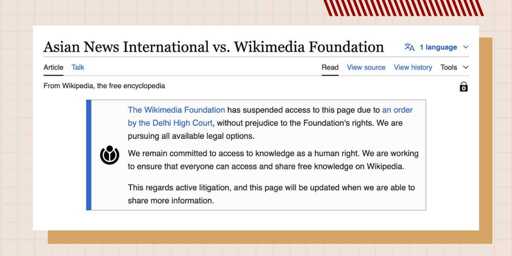
https://en.wikipedia.org/wiki/Wikipedia:ANI_vs._WMF_Delhi_court
The admins from India have only been accused of defamation. Now that the court has their identities, the actual statements will be examined to see if they do actually contain defamation. So anyone can go on a fishing expedition to get someone’s identity, and then say ‘oops, no laws were broken after all’, and now that we know who you are, it would be a shame if someone fell out of a window or something. And of course whatever is in the “sealed” document is now out, India is one of the biggest places for bribery there is. They are also saying the documents will be unsealed at the end of the court case, so it might be cheaper to just wait until they are published.
-
wikipediasuckscoop@lemmy.worldOPto
Technology@lemmy.world•Is the Wikimedia Foundation about to sell out its editors—and its principles?English
114·2 years agoWikipedia unfortunately has a policy of blocking so-called open proxies.
wikipediasuckscoop@lemmy.worldOPto
Technology@lemmy.world•Is the Wikimedia Foundation about to sell out its editors—and its principles?English
212·2 years agoThat edit was intended for people who downvoted the comment for unknown reasons.
wikipediasuckscoop@lemmy.worldOPto
Technology@lemmy.world•Is the Wikimedia Foundation about to sell out its editors—and its principles?English
214·2 years agoAnd that’s only the tip of the iceberg.
wikipediasuckscoop@lemmy.worldOPto
Technology@lemmy.world•Is the Wikimedia Foundation about to sell out its editors—and its principles?English
1860·2 years agoIt’s likely that the editors and principles have been betrayed by this point and thus Encycla and ibis.wiki should be the places we can flock to.
Edit: What’s going on with the downvotes? What is despicable or freakish about discussing Wikipedia through a critical lens?
X, for example, is discussed through a critical lens ad nauseum in many mainstream publications throughout the English-speaking world. Do you find that despicable, too?
Wikipedia has very big problems that profoundly effect public discourse. Yet almost nobody knows about them.
Out of curiosity, why is criticism of Wikipedia so infuriating to you? You can just take a look at what Tracing Woodgrains had written about Wikipedia or rather, the following by Aaron Swartz who’ve seen the problems far away.
http://www.aaronsw.com/weblog/wikiroads
I’ll be blunt here for die-hard defenders of Wikipedia; are you going to die on a wrong hill where the Andrew Tate fanboys are currently on just because of a website and institution which is far from perfect just like X, Meta, and United Nations?
wikipediasuckscoop@lemmy.worldOPto
Technology@lemmy.world•Reliable Sources: How Wikipedia Admin David Gerard Launders His Grudges Into the Public RecordEnglish
27·2 years agoTo everyone who’re dissing the Substack article here, at least the much-derided “Reddit hivemind” has more sense than ya’ll.
I’ll just leave this here without comments.
As someone who had this article randomly recommended to me and followed a google search of Gerrard here, I have to say I’m disappointed and mildly concerned by the tone of people’s criticisms of the article. It reads like people who feel compelled to unquestioningly defend a colleague rather than evaluate the claims. Comments like “that is precisely how an encyclopaedia is supposed to work”, “Somebody’s butthurt their edit got reverted by this guy”, ““I am a republican and am angry that this guy isn’t” lmao” do not engender confidence in the community. People arguing against Gerrard also seem fixated on fighting the culture war and disparaging Gerrard’s character rather than elucidating the specific wrongdoings.
The article is not well structured. The author meanders between a specific accusation(continuous and malicious violation of a policy), a psychoanalyzing biography, public curiosity, criticism of various sources/policies, and thinly veiled personal animosity. Worse, it leads with the personal animosity and asks us to take much of the narrative connecting the individual references on faith.
However, Gerard’s consistent and seemingly unrepentant use of his authority to further personal feuds is very upsetting to hear. That is not behavior I want to be tolerated from major Wikipedia editors, and it makes me doubt the general credibility of articles I read. This form of abuse of power speaks to a general personality flaw that I find unlikely to be limited to one incident, especially given the quote of him apparently crowing over his manipulation. If the treasurer of an organization embezzles money from one bank account, we don’t just remove them from that one account; we would remove them from any role of financial authority.
Gerard’s extensive use of a secondary source he contributed to, to justify his edits also seems very bad. However, the article is unclear if it violates a Wikipedia rule.
The article paints a fantastic picture of Gerard’s edit history as obsessive and calculating. I find the argument plausible but unconvincing, it is functionally a ‘just so’ story that relies on the above actions to characterize Gerard as the type of person who could act this way. There are people, especially ultra online people, who are obsessive and calculating, people who will dedicate immense time to carefully employ social manipulation and institutional power to advance a narrative over years and years. I sincerely wish the article had spent more time establishing the motive, context, and specific tactics it accuses Gerard of. Instead, it makes an assertion and links to diffs. I understand the author that these are self-evident, but they are not. Showing manipulation on the scale alleged requires step-by-step walk through the interaction. Otherwise, it is too easy to cast innocuous behavior as malicious.
In addition, this section is harmed by being interwoven with tangentially related social commentary and personal disgust.
The alleged behavior is upsetting. However, I don’t think the article makes a convincing case for it. It is also the sort of bad behavior I expect in any large organization.
The article makes the mistake many accusations make by being more of a list of the author’s grievances than advancing a specific narrative of wrongdoing. However, at least the first two accusations seem well-founded, and a reflective community should critically engage with them rather than reflexively closing ranks against criticism.
I should disclose I occasionally read Scott Alexander’s blog, although I think he is overly conspiratorial about the NYT article, also I think yud is silly. I don’t believe I feel any significant emotionality in Gerard’s fight with rationalists.


Even better, fork Wikipedia.
https://ibis.wiki/