I don’t understand. You will still need to do administrative tasks once in a while so it isn’t really unnecessary, and if root can’t be logged in, that will mean you will have to use sudo instead, which could be an attack vector just as su.


I don’t understand. You will still need to do administrative tasks once in a while so it isn’t really unnecessary, and if root can’t be logged in, that will mean you will have to use sudo instead, which could be an attack vector just as su.


It doesn’t wrap in the default web interface.
Windows also uses linefeeds, they just also add carriage returns.
That’s w3m, an Emacs web browser, not webm the WebM file format.
Between IRC and the picture representing the idea of self-hosting, there’s the XMPP logo, which like IRC, is an instant messaging protocol (but with more features than IRC).
The FSF-approved distributions that are shown are: Trisquel, Parabola and GNU Guix (this one is actually quite neat, it’s based on NixOS with its own ideas like the importance of being able to bootstrap an entire system from a minimal binary seed)
The browser with logo shown is GNU IceCat, with binary blobs removed and with some extra security and privacy features (among them an addon that prevents the browser from running proprietary javascript)
lynx is a simple TUI web browser and w3m also is a similar browser but running in GNU Emacs
The last three are all the GNU Emacs logo.
I’ve been wondering why not window.chrome == true or Boolean(window.chrome), but it turns out that the former doesn’t work and that == has essentially no use unless you remember some completely arbitrary rules, and that JS developers would complain that the latter is too long given the fact that I’ve seen javascript code using !0 for true and !1 for false, instead of just true and false because they can save 2 to 3 characters that way.
Why the double negation?
The huge differentiator is that KDE may look like windows OOTB on most distros, but if you want you can easily make it look like Gnome, Mac, Unity… whatever. The panels and menus are infinitely configurable.
Is there a way to configure the look of all the apps running on kde? Because one of the main things that keeps my away from KDE is how ugly all the k* apps look out of the box.
I actually like Gnome. I like the way it looks and I have no problems with UX. I also don’t feel the need to use any extensions.
¯\_(‘_’)_/¯


Oh to see a medieval peasant’s face after reading them this headline.
I spent around an hour trying to understand how to use Fedora’s manual partitioner. I think I just ended up partitioning it with gparted or cfdisk from a different system. Never had problems with manual partitioning on other distros’ installers.


Didn’t Microsoft just recently get a law suit for such practices or am I mixing it up with Google (who now can’t pay Mozilla anymore to ship their browser with google as the default search engine)?


What kind of data does listenbrainz and last.fm store and what are they used for?


Also doesn’t display anything without javascript


I don’t think ð was pronounced exactly the same way as thSeems like I was thinking of other languages where they were/are pronounced differently.
Btw, what is a non-local RSS reader? I have come across multiple that RSS readers that advertise being “self-hosted” and I’m confused about that since in my mind RSS readers are simply clients that periodically query different servers for an .rss file, so I’m confused about where there is anything to host besides the host of the .rss feed.
That code was C++ or something like that. Not GDScript.
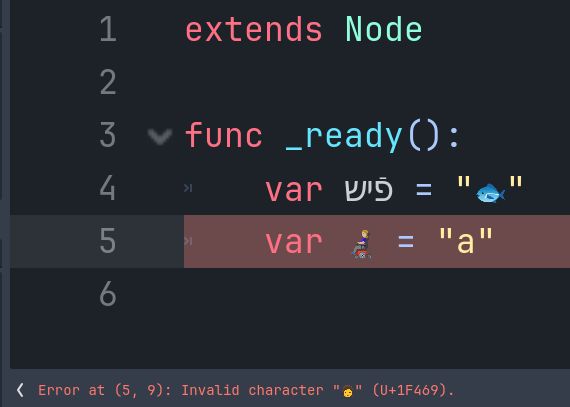
I tested this on Godot 4.2.1. You can write identifiers using a different writing system other than latin and you are allowed to have emojis in strings, but you aren’t allowed to use emojis in identifiers.

What if you don’t have a static IP, do you ask your ISP in what range their public addresses fall?